If you like this blog you can subscribe on the sidebar or at the bottom of the page on your mobile device. If you want hear things that relate to this blog, the Council Conversation Podcast (link in the top bar, here and on all major podcast platforms) zooms out and looks at SW Ontario more broadly. Heck if you like both, I have a patreon and you can buy me a pint or a cup of coffee it would be appreciated!
This week saw some dramatic coverage on the Housing file in Windsor. I am going to skip the usual CMHC breakdown to dig into some of the data drama that emerged. For those not following here is the timeline.
On Jan 31st, it was announced that the City of Windsor Housing Accelerator Fund application was reject. The news seem to be broken by the Globe and Mail – who had a reporter in the City this week, kudos to them! People should go and read the Windsor Star’s story on “What to know about the Housing Accelerator Fund” to get a background on the fund.
This then set off a bit of a tizzy of with Mayor Dilken’s releasing a statement stating Windsor’s position. MP Irek Kusmierczyk making long social media posts positioning the refusal in the broader context and the CBC Windsor Q&A with the Housing Minister. This triggered a debate between two numbers – the housing minister saying Windsor only had 346 housing starts in 2023. This number is directly from the Provincial tracker that tracks housing starts across the province. Late on Friday, the City released a statement that – that the City issued a record number of building permits which is 1,154 (note 60 units were demolished this year so net new units was just under 1,100). They couldn’t specifically state how many of these permits had shovels in the ground but seemed optimist. The Windsor Star beat me to breakdown what is behind this gap but I think there is a bit more than the story covers.
The challenge the City of Windsor faces is that the provincial dashboard pulls data from CMHC, not specific reports from cities. The provincial website it states:

As a result for the City’s data it does not match the standardization of all the other data on the tool. I certainly believe they issued 1,154 permitted units, but how many permits did Toronto release, what about Woodstock? Although the City through inspection data says that many of those units are under constructions, how many of them actually are, and for those constructions how far along are they? Building permits generally do not have an expiration date on them. A developer could sit for 6 months holding their permits, in the hope that interest rates tick down 1% – which will save them lots of $$$. The City claims that doesn’t happen often but we don’t really know.
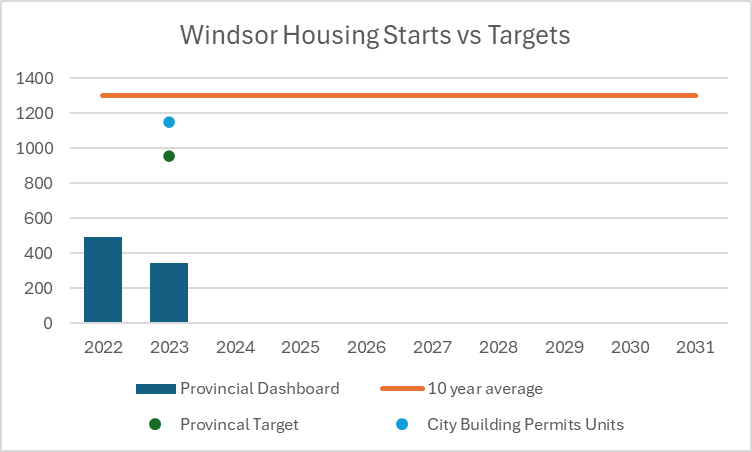
Part of the problem is, I haven’t been able to find what the yearly targets are for Windsor. I am sure they are out there somewhere or in a report to Council but beyond getting to 13,000 units bey 2031 I don’t see any specific targets. We know we need to average 1,300 units per year for 10 years, this year’s target was 953 starts, which means at minimum we are accepting a higher target somewhere in the future to get us on pace. As a result of this information void and we end up with gaps in our understanding of our progress. Why is there a gap between the Provincial Dashboard and the City Building Permits?
Well as outlined in the Windsor Star story CMHC leverage building permit data but then use local enumerators to actually check in on the a building site. If a foundation or footings are poured, then construction has “started”. The city is counting it’s own measure of “units”, which is NOT what the province is tracking! CMHC uses units as well, they count units in the starts:
Dwelling unit: In the Starts and Completions Survey, a dwelling unit is defined as a structurally separate set of self-contained living premises. A dwelling unit has a private entrance from outside the building or from a common hall, lobby or stairway inside the building. The entrance must be one that can be used without passing through another separate dwelling unit.
CMHC Housing Market Survey Definitions
Looking at the data below and in past posts ex November, when an apartment “starts”, they aren’t counting 200 separate apartment projects, it one building with 20 units and another with 40 units etc. They are counting the number of units. In November when 36 apartment units were started in Windsor, that wasn’t 36 buildings, it was likely 1 or 2 projects in the city. As a result the City is unnecessarily conflating the housing data.
Now, CMHC tracking isn’t perfect, I assume they aren’t checking every day, on every potential building lot and there is a monthly reporting cycle. There is also maybe some gap between a permit is issued, and when a foundation gets poured – bad weather could day a start for a week or two. So certainly there can be some fuzziness when a project may get missed in a particular month. CMHC releases this data on the 11th working day of a month so obviously there is some time gap but over the course of a year, you are probably capturing 95+% of the starts that actually happen.
The City’s suggestion that the Dashboard isn’t up to date is a tough one to grapple with. The province is not going to change a standardize methodology for the City of Windsor. The province needs to track housing starts for dozens of cities – see their dashboard again. If we are just measuring permits and multiplying by the number of units in the building. I am sure a number of municipalities are going to have better results than the standardize methods that are being used.
Given that the City of Hamilton seems in line to receive $12 million funds the Building Faster Fund under the criteria where they hit 97% of their target – there is money on the line here too. Windsor needs to meet 80% of it’s target to receive funding through the Building Faster Fund. We got to 36%! There are likely millions of dollars in funding and bonuses available if the City hits its targets, the question is, can it do it without begging the province to change how it is measured?
The tool does hint at forthcoming changes, but only for specific types of housing that are outside of general CMHC collection. I spent a year and a half working on adusearch.ca because CMHC does not track ADUs or basement units. In Toronto, the School of Cities is tracking these units based on City building permit data. CMHC also don’t regularly track things like long-term care homes and student residences. Certainly some accommodation for these types would require direct municipal input, but to change the core collection method midstream is a big ask! As the province has a set of targets based on a specific calculation based on CMHC, and the City agreed to it (required for strong mayor powers) if you aren’t meeting their basic measures and trying to change how they measure it, how serious were you in the first place?
As for Windsor Essex the following are the starts and completions for all of 2023 according to CMHC.
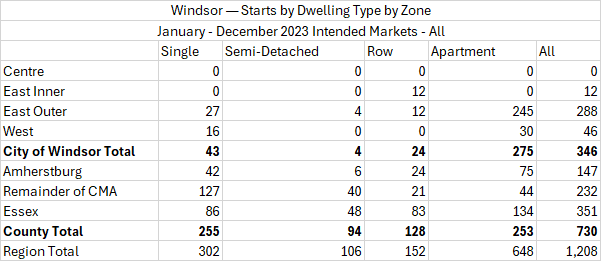
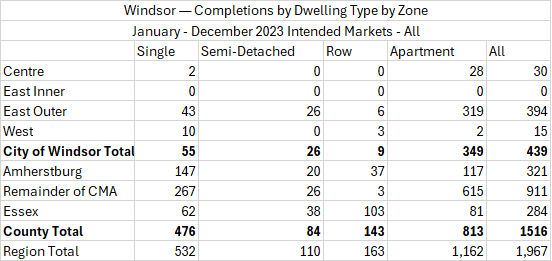
As mentioned in previous posts the numbers aren’t great. The County continues to out build the City, note they are not in the provincial dashboard. You can see the specific number of units across number of housing types, my confusion with the city’s numbers is compounded.
What is the pathway forward?
The City has missed out on one pot of money and is likely to miss out on another. There will be implications for that.
My suggestion for the City of Windsor is to release it’s building permit data onto it’s open data portal. Many other cities already do this, providing: numbers of building permits, addresses, unit types, open/close dates etc. that allow anyone to see what is being built and where in the city. If the City wants to claim it has accurate data, it is going to need to prove it. What better way than to share with the City’s residents who are very concerned about the types of development that are occurring in their neighbourhoods. That data could be paired with inspection data which could also be released as permit as both are public records and in theory accessible.
Beyond this, obviously not receiving funds from HAF and potentially not from Building Faster Fund is a big hit. Potentially tens of millions of dollars missed out on, I hope that the councillors who supported the HAF as well as the media regularly asks questions about whether or not housing related projects would have been supported by these funds if we have received them. Unfortunately the proposals in the public agendas are not specific, and during the debate administration stated in non-specific manner that some project would move forward without the funding others activities are only going to occur with funding. So asking questions going forward will be important.
The City budget passed on Friday, and within the budget document there was 1 role related to the Housing Accelerator Fund:

Although supposed to be funded out of “one-time funding through the fund, the risks outlined in the budget report state:
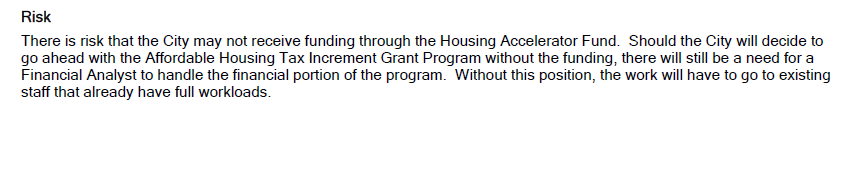
If the city wants to move forward with an affordable housing tax grant to encourage the development of affordable units, there are no staff to to do the work. Regardless, the City is going to have to make up some funding. It does have a number of projects in the pipeline (my next post) that can give some optimism around future targets, the question is when do those shovels get in the ground?
 gingerpolitics
Excellent analysis, Frasier.
Big debate right now between mayors and Premier about whether to count permits or starts when deciding bonus housing grants. Lots on the line. Let’s hope we avoid compounding funding drops.
Thanks for the comment Irek!